Think about the end of a concert.
At first, the applause is a messy roar. Everyone claps at their own speed. Then, sometimes, something strange happens: little pockets of people start clapping together, those pockets grow, and soon the whole hall is clapping in one shared rhythm.
Nobody gave a signal. The rhythm emerged on its own.
Physicists have now built a material that does something similar.
It starts with lots of small, messy wiggles. Over time, those wiggles grow, merge and slow down, until the whole material moves together in one steady beat.
Researchers built a honeycomb of 37 small robotic cells
The team, led by Corentin Coulais at the University of Amsterdam and Anton Souslov at the University of Cambridge, built what they call a mechatronic metamaterial.
That sounds intimidating, but the idea is simple.
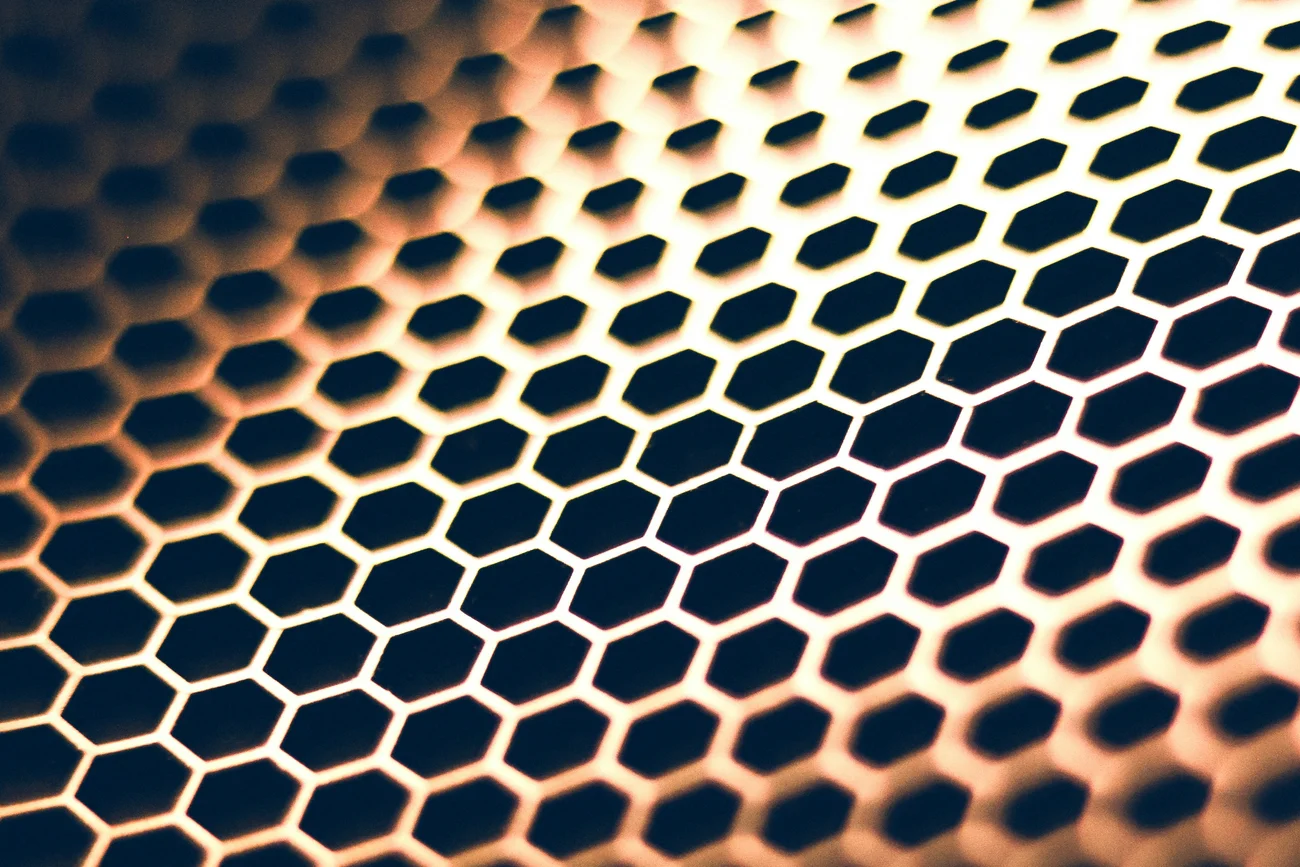
Picture a flat honeycomb made of 37 small six-sided cells, a bit like a section of a bathroom floor tile pattern, but where each tile can flex and stretch.
Each cell contains three everyday technologies:
- A tiny motor of the same kind that makes a loudspeaker vibrate, which can push and pull on the cell.
- A magnetic sensor, similar to the one in your phone that knows which way is north, which measures how the cell is bending.
- A tiny computer chip, like the one inside a washing machine, which reads the sensor and tells the motor how to push.
So the material isn’t magic. It’s plugged in and powered, more like a team of tiny robots holding hands than a lump of rubber.
The cells were programmed to push on each other unequally
Here’s the clever part.
In ordinary materials, forces are fair. If you push on a wall, the wall pushes back on you just as hard. Physicists call this reciprocity.
The researchers programmed their cells to break that rule. Neighbors push on each other unequally, a bit like two people on a seesaw where one is secretly allowed to push harder.
This “unfair” or non-reciprocal pushing feeds energy into the system. Instead of calming down, the cells start to wobble on their own, like a swing that keeps getting a little extra push every time.
Small, fast ripples merged into one big, slow wave
At first, the honeycomb shows small, fast, short ripples, little local wiggles going in all directions. Think of rain hitting a puddle: lots of tiny, disorganized rings.
Then, over time:
- the ripples get longer (each wave stretches across more cells),
- they get slower (each wiggle takes longer to repeat),
- and they get bigger (the cells move further).
Eventually, the waves span the entire material, and everything moves together in one large, slow, synchronized motion.
The researchers call this wave coarsening.
The same merging happens in salad dressing
Coarsening is something you’ve seen in your own kitchen.
Shake a bottle of oil-and-vinegar salad dressing. At first, it’s full of tiny droplets. Leave it on the counter, and the little droplets merge into bigger ones, until the oil and vinegar form two big layers. Small patches grow into big ones.
Scientists see the same process in metals, foams and even the way galaxies cluster.
What’s new here is that it happens not with blobs of stuff, but with waves of motion. Small, quick wiggles merge into bigger, slower ones, just like droplets merging into larger drops.
A time crystal repeats in time instead of space
An ordinary crystal, like table salt or a snowflake, has a pattern that repeats in space. Look closely at salt and you’ll see atoms lined up in a neat grid, the same arrangement repeated over and over.
A time crystal has a pattern that repeats in time. Instead of a grid of atoms, it has a motion that keeps cycling: back, forth, back, forth, like a heartbeat or a pendulum clock.
The key is that the rhythm comes from inside the system. Nobody is tapping it from outside at that tempo. The honeycomb settles into its own beat, like the concert crowd that synchronized its clapping without a conductor.
Adding friction stopped the merging partway
The researchers also tested what happens when they add the equivalent of friction, like dragging the material through honey.
That stops the coarsening partway. Instead of one giant synchronized wave, the material settles into other lasting patterns, including waves that travel around its edges, a bit like a stadium “Mexican wave” circling the outer rim of the crowd.
What the study doesn’t show
This is a peer-reviewed study in Nature, backed by experiments, computer simulations and theory. But it’s important to be clear about what it is.
It’s not perpetual motion. The material is powered. The rhythm only continues because the motors keep feeding energy in.
It’s a lab demonstration. The honeycomb has 37 cells. It shows a physical principle, not a ready-made product.
Applications are still ideas. The authors suggest uses in sound control, soft robotics and understanding living tissues, but these haven’t been built or tested.
Order can emerge without a leader
We usually think of order as something imposed from outside: a conductor leading an orchestra, a clock driving a machine.
This study shows that simple local rules, each cell only reacting to its neighbors, can produce large-scale order on their own. That’s how flocks of birds, schools of fish and even groups of heart cells coordinate.
Understanding how that happens could one day help engineers build soft robots that coordinate their movements without a central brain, or materials that adapt their motion to their surroundings.
Sometimes order doesn’t need a leader, just neighbors who keep pushing each other in the right way.