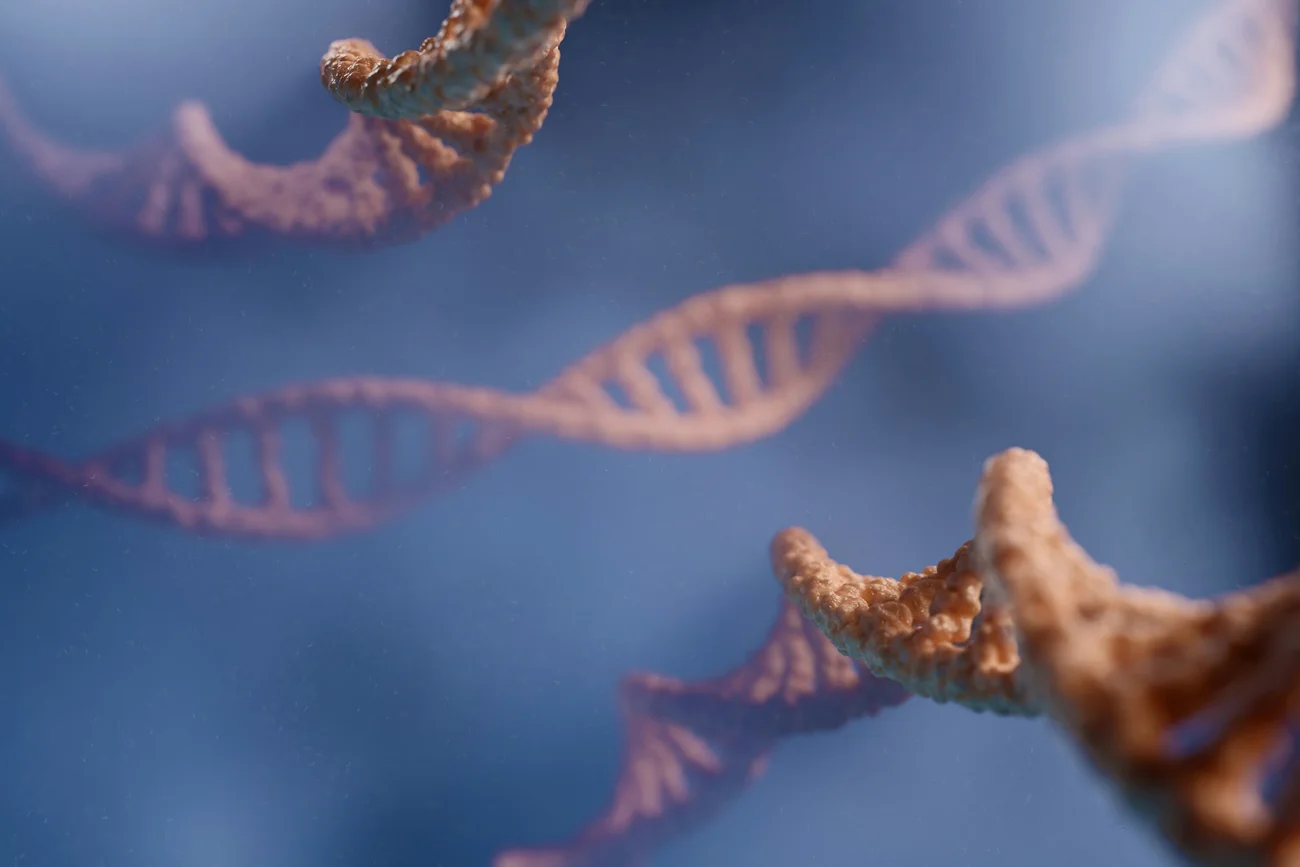
Every time one of your cells divides, the tips of its chromosomes wear down a little. Those tips, called telomeres, are protective caps made of the same short DNA sequence repeated thousands of times.
An enzyme called telomerase rebuilds them. It is one of the most famous molecules in biology, central to research on ageing and cancer, and the subject of a Nobel Prize in 2009.
Most of us would assume such a basic piece of human machinery evolved for its current job. A new study in Nature suggests it may have started out as something else entirely: a weapon bacteria used to fight viruses.
A bacterial defence enzyme builds repetitive DNA the way telomerase does
A team led by Samuel Sternberg at Columbia University, working with colleagues in Copenhagen and the Basque Country, studied a bacterial defence system they call DRT10.
Bacteria are constantly attacked by viruses called phages. Over billions of years they have evolved a large arsenal of defences. DRT10 belongs to a family of these defences built around a reverse transcriptase, an enzyme that reads RNA and writes DNA.
What makes DRT10 remarkable is how it writes. The researchers found that it:
- Carries its own small RNA molecule, which acts as a template
- Copies a short stretch of that template into DNA
- Then slips back and copies the same stretch again and again, producing long DNA made of tandem repeats
- Stops each copy at precise boundary markers built into the RNA
That is almost exactly how telomerase works. Telomerase also carries its own RNA template, copies a short segment of it, resets, and repeats, adding the TTAGGG sequence to the ends of human chromosomes over and over.
Structures, biochemistry and family trees pointed the same way
The team combined three kinds of evidence:
- Structures. Using cryo-electron microscopy, they captured DRT10’s shape. Two copies of the enzyme sit on opposite sides of a single RNA, but only one of them produces the long repetitive DNA.
- Biochemistry. They showed that the length of each repeat is set by the spacing between two loops in the RNA. Change the spacing and the product changes.
- Evolutionary trees. They compared reverse transcriptases from all domains of life. Telomerase did not sit apart. It fell in the same branch as this group of bacterial defence enzymes.
An earlier preprint from largely the same team added a striking experiment. When they swapped DRT10’s template for the template from human telomerase RNA, bacteria began producing human-style telomere repeats. The same trick worked in human cells grown in the lab.
How repetitive DNA stops a virus is still unknown
This is the open question. In the team’s preprint, DRT10 protected E. coli, and the protection disappeared when the enzyme’s DNA-writing ability was disabled. So the repeat-making is essential to the defence.
But exactly how a string of repeated DNA stops a virus is not yet known. The team’s preprint describes the immune role of the DNA product as unresolved, and the publicly available text does not report how large the protective effect is.
Some of biology’s key tools began as bacterial weapons
This finding fits a pattern that has quietly reshaped biology.
The best-known example is CRISPR. It began as a bacterial immune system that remembers and cuts viral DNA. Scientists then turned it into the gene-editing tool now used in medicine.
Sternberg’s lab has been exploring this family of defence enzymes for years, and it keeps finding strange behaviour:
- One relative (DRT2) builds an entirely new gene from scratch when a virus attacks.
- Another (DRT9) churns out long strings of a single DNA letter.
- Now DRT10 makes telomere-like repeats.
The arms race between bacteria and viruses has run for billions of years, across countless organisms. It is easy to see it as a vast evolutionary laboratory. Some of the tools it invented appear to have been borrowed by complex cells and given new jobs.
If the researchers are right, telomerase is one of them. A molecule that now protects our chromosomes may have first been a way for microbes to defend themselves.
What the study doesn’t show
The research is peer reviewed, published in Nature as an accelerated article preview. That means the final edited version may still change slightly.
The mechanism is well supported by structures and lab experiments. The evolutionary story is an inference. Family trees of enzymes show relatedness. They cannot replay history.
Specifically:
- The tree places telomerase in the same broad group as these bacterial enzymes. It does not prove DRT10 itself is telomerase’s direct ancestor.
- How an ancient bacterial enzyme reached early complex cells remains unknown. Gene transfer between microbes or the merger that produced the first complex cells are possibilities the team raises, not findings.
- Much of the lab work used engineered E. coli and a limited set of viruses.
- The study says nothing directly about human ageing or cancer. It concerns where telomerase came from, not how to change what it does.
Our cells’ essential machinery may have old origins
Telomerase sits at the centre of two big human health questions. Most cancers reactivate it to keep dividing, and short telomeres are linked to ageing tissues.
Knowing its origin will not produce a treatment tomorrow. But understanding how this kind of enzyme works in a simpler bacterial form gives researchers new models to study. Scientists have already reprogrammed DRT10 to make human telomere repeats, which hints at future research tools in the way CRISPR did.
It also changes the story we tell about ourselves. Some of our cells’ most essential machinery was not designed for us. It was inherited, repurposed, from an ancient war we never knew we were part of.
The caps that protect your chromosomes may be souvenirs of a battle between bacteria and viruses.