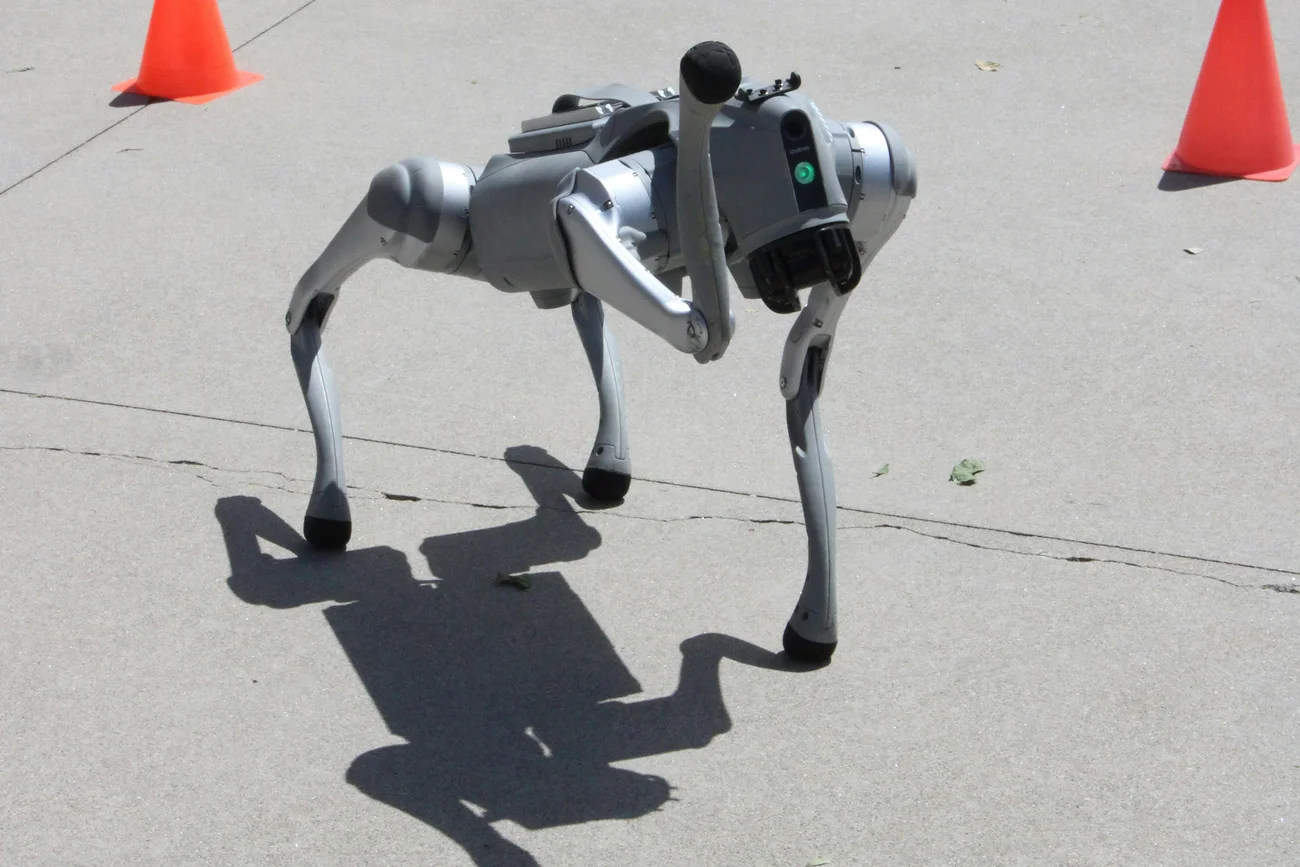
Four-legged robots can climb stairs, cross rubble and recover from a shove. What most of them can’t do is keep going.
Many of today’s quadrupeds run out of battery after a couple of hours or roughly 20 kilometres. For inspection, patrols or search and rescue in places without chargers, that’s a serious limit.
A team at KAIST in South Korea set out to fix it. Their robot, RAIBO2, ran a full marathon on a single battery charge, and it did so using less energy per kilogram per metre than a typical human runner.
RAIBO2 ran a full marathon on one charge in about 4 hours 20 minutes
In November 2024, RAIBO2 was officially registered in the Sangju Dried Persimmon Marathon in South Korea. It ran the full 42.195 km alongside human runners on public roads with hills and slippery sections.
- Finishing time: 4 hours, 19 minutes and 52 seconds
- Average speed: about 2.7 metres per second, close to 10 km/h (our calculation)
- No recharging or battery swaps
The robot carried a 2 016 watt-hour battery and used about 1 280 Wh, roughly two-thirds of it. Based on the race data, the team estimates it could have gone about 65 km on a full charge. That’s around three times the range of existing quadruped robots.
The research team, led by Jemin Hwangbo, published the full analysis in Nature on 23 September 2026.
It used less energy per kilo than a human runner
Engineers compare the efficiency of walking machines and animals using cost of transport: how much energy it takes to move one unit of body weight over one unit of distance. Lower is better.
RAIBO2 achieved a total cost of transport of 0.25. A typical human runner is around 0.37. The team says it’s the first quadruped robot to beat the human benchmark.
Legs leak energy on every step
Wheels roll. Legs have to lift, swing, land and push off, again and again. Every step leaks energy in several places:
- Heat in the motors. The analysis found the biggest losses were electrical, mainly from current heating the motor windings.
- Friction in the joints.
- Impact when the feet hit the ground, and slipping as they push off.
- Always-on electronics. Computers, sensors and radios keep drawing power however fast the robot goes.
That last point creates a trap. Go too slowly and the electronics burn energy for hours. Go too fast and impacts and leg motion waste more. RAIBO2 was most efficient at around 3 metres per second.
And simply adding a bigger battery doesn’t solve it: a heavier robot needs more energy to carry itself.
The gains came from improving the whole machine, not one part
The team treated range as a whole-system problem, not something to fix with one better part.
- Lighter legs, which take less energy to swing on every stride
- More efficient motors and drive electronics, to cut heat losses
- Recovering energy on downhill stretches, partly recharging the battery
- A walking controller trained with reinforcement learning, a type of machine learning that learns by trial and error in simulation, tuned to reduce hard landings, slipping and wasted motor current
Think of it like a cyclist rather than a weightlifter. Raw power matters less than wasting as little as possible on every revolution.
Range decides whether a robot can do real work
Much of the excitement in robotics today is about AI: smarter software that lets machines see, plan and act. RAIBO2 is a reminder that hardware and physics still set the limits.
A robot that can patrol a pipeline, inspect a power line or survey a disaster zone is only useful if it can get there and back. Range is the difference between a demo and a working tool.
Hwangbo’s startup, Lion Robotics, is already selling RAIBO2 units and testing them for industrial and defence uses, according to Korean media.
What the study doesn’t show
- One robot, one race. It’s a hand-built research machine. Making many reliable, affordable units is a separate challenge.
- Running a road course isn’t working. The marathon didn’t involve carrying sensors, tools or cargo, or crossing rough terrain, which would cost more energy.
- The range estimate is extrapolated from the race data, not demonstrated in a single longer run.
- Real-world conditions like rain, dust, extreme heat or cold weren’t tested. The company says it’s pursuing certification for these.
- The human comparison is a benchmark, not a head-to-head with specific runners.
Walking far may be the next breakthrough
Teaching robots to walk was the first breakthrough.
Teaching them to walk far, without wasting energy on every step, may be what finally puts them to work.