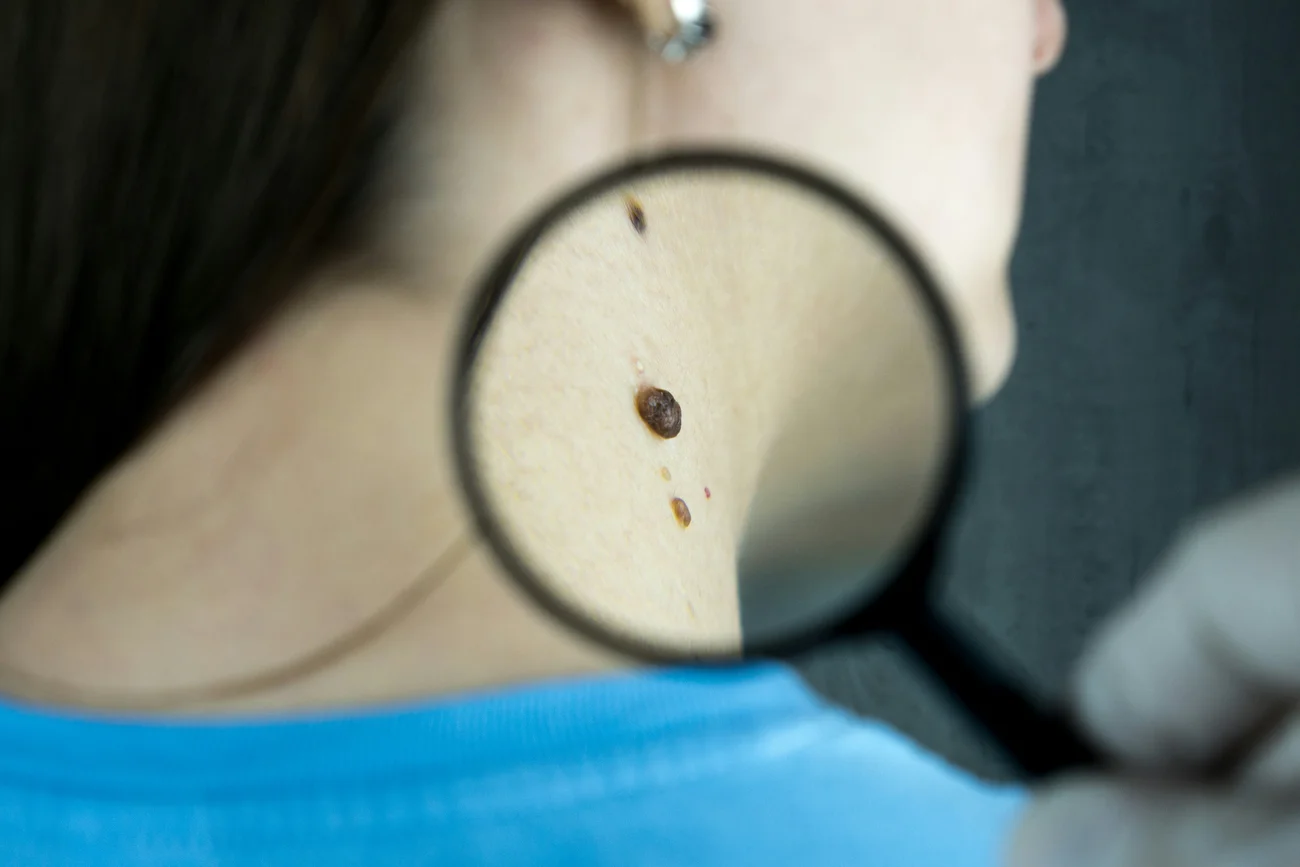
Cancer drugs are normally made the way other medicines are: one product, manufactured in bulk, given to everyone with the same diagnosis.
A trial presented in October 2026 tested the opposite approach. Each patient received a vaccine designed from the genetic mistakes in their own tumour, and made for them alone. It is the first time a large, late-stage trial has shown that such a one-patient-at-a-time vaccine keeps cancer from coming back.
A tumour’s own mutations were used as the target
Cancer cells carry mutations that healthy cells do not. Some of them change the proteins on the cell’s surface, which makes the tumour look slightly foreign. These altered fragments are called neoantigens, and they differ from one patient to the next.
The vaccine, intismeran autogene, is built around them. After a patient’s melanoma is removed, the tumour is sequenced, a set of its neoantigens is chosen, and an mRNA molecule carrying instructions for those fragments is manufactured. It is the same kind of technology as the mRNA vaccines against COVID-19. Injected, it shows the immune system what to hunt for.
It was given together with pembrolizumab, an established immunotherapy that takes the brakes off immune cells. The vaccine points the immune system at a target, and the drug frees it to attack.
More than a thousand patients were randomised after surgery
The trial, called INTerpath-001, enrolled 1 137 people whose melanoma (stage IIB to IV) had been completely removed but was at high risk of returning. It was run by Merck and Moderna, which make the two products.
Two patients received the vaccine plus pembrolizumab for every one who received a placebo plus pembrolizumab. Neither patients nor doctors knew who was in which group. The results were presented by Georgina Long of Melanoma Institute Australia at the ESMO cancer congress in Madrid.
The cancer came back in 18% of vaccinated patients, against 29% of the others
After a typical follow-up of just over two years:
- The risk of the cancer returning, or of death, was 42% lower with the vaccine (hazard ratio 0.58, with a 95% confidence interval of 0.45 to 0.75).
- At two years, 82% of vaccinated patients were free of recurrence, against 70% of those on immunotherapy alone.
- The risk of the cancer spreading to distant organs was 38% lower.
In everyday terms, out of every 100 patients, about 12 more were still cancer-free at two years. That is roughly one extra person for every eight or nine treated.
The benefit did not appear at once. In the first six months the two groups did equally well. After that, once the full course of vaccine had been given, the risk of recurrence was 58% lower in the vaccinated group.
The vaccine added side effects, mainly fever, tiredness and soreness where it was injected. Severe side effects judged to be caused by treatment were about equally common in both groups, at 14.2% against 13.4%. Counting severe medical problems of any cause, the figures were 23.6% and 20.3%.
A treatment designed for one person has now passed a large trial
Earlier, a mid-sized trial of the same vaccine had given encouraging results. Phase 3 trials are where many promising cancer treatments fail, and previous attempts to improve on immunotherapy alone in this setting, by adding a second immune drug, did not succeed.
That is why this result matters beyond melanoma. It shows that the whole chain can work at scale: sequencing a tumour, designing a vaccine, manufacturing a single patient’s dose and delivering it in time. The companies are testing the same approach in lung cancer and other tumours.
A standard drug treats the disease. This one is built from the patient’s own version of it.
Independent experts were impressed by the design. “This is the Rolls-Royce of clinical trials,” said Lennard Lee, a cancer vaccine researcher at the University of Oxford. He also raised the obvious difficulty. Every dose has to be designed, made and shipped for one person, which is complex and likely to be expensive, and it is unclear how that could be offered worldwide.
What the trial doesn’t show
- It has not yet shown that patients live longer. Deaths so far are too few to tell: the estimate leans towards a benefit, but the uncertainty is wide enough to include none.
- The results come from a conference presentation and company statements. We have not seen a full peer-reviewed paper.
- Both the vaccine and the drug belong to the companies that funded and ran the trial.
- Follow-up is about two years. Melanoma can return later.
- Making a vaccine needs a tumour sample good enough to sequence, and time to manufacture. The figures here are for patients who got that far.
- It is not available outside trials, and regulators have not yet ruled on it.
- The result is for melanoma after surgery. Other cancers may respond differently.
Each cancer’s mutations are also its weak point
The mutations that make a tumour dangerous also mark it out. This trial is the strongest evidence so far that medicine can read those marks for one person and act on them.
For now it is a research result, not a treatment you can ask for, and the survival data are still to come.