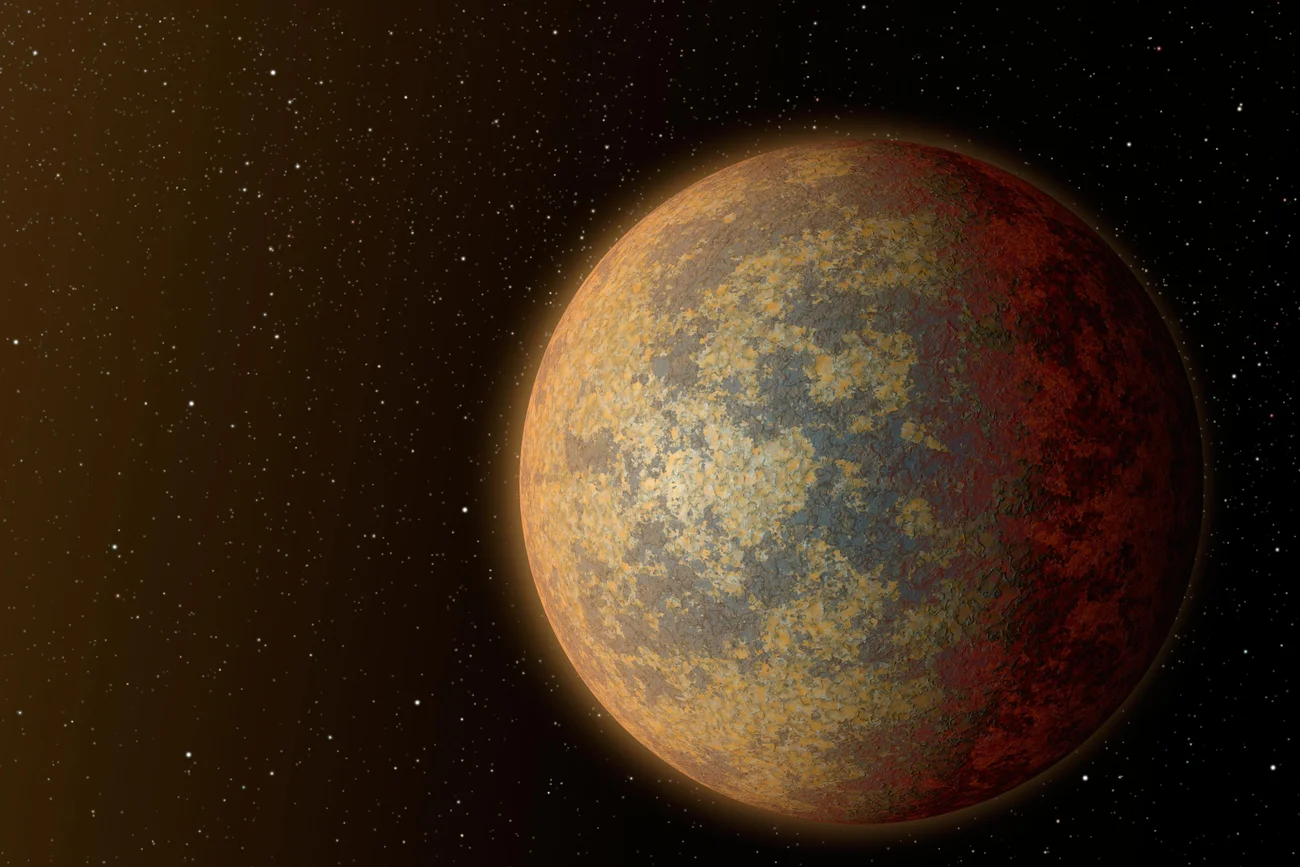
Imagine a planet made of rock and metal, like Earth.
Now make it more than ten times heavier.
Astronomers have reported a handful of planets just like that. They call them mega-Earths: giant, dense, rocky worlds that shouldn’t really exist.
But a new study suggests something surprising.
Some of those planets may never have been that heavy. The measurements may have been fooled by their stars.
Rocky planets this heavy should have become gas giants
Here’s why mega-Earths are so strange.
When a young planet grows, it pulls in material around it. Once its rocky core gets big enough, roughly 10 times Earth’s mass, its gravity becomes so strong that it starts grabbing huge amounts of gas.
The result is usually a gas-wrapped world, more like Neptune or Jupiter than Earth.
So a planet that’s ultra-heavy and still bare rock is a puzzle. Explaining one requires unusual formation stories.
Every reported mega-Earth orbits an active star
Two astronomers at McGill University in Canada, Casey Brinkman and Nicolas Cowan, looked at every reported ultra-massive rocky planet in the scientific literature.
They spotted something odd.
Every single one orbits an active star.
Active stars are restless. Their surfaces bubble with dark starspots and bright patches, and they are more magnetically active than calmer stars like our Sun.
The researchers calculated how likely it would be for all of these planets to orbit active stars just by chance.
Less than 1%.
And they found no reason in astrophysics to expect giant rocky planets to form specifically around active stars.
Their conclusion: mega-Earths are likely an artifact, a side effect of how the measurements were made.
Planets are weighed by the wobble they give their star
You can’t put a planet on a scale. Most of the time, astronomers can’t even see it directly.
Instead, they watch the star.
As a planet orbits, its gravity tugs its star in a tiny circle. The star moves slightly toward us, then slightly away, over and over. Astronomers detect this wobble as tiny shifts in the color of the starlight.
The bigger the wobble, the heavier the planet.
Combine that mass with the planet’s size, measured when it passes in front of its star, and you get its density. High density means rock and metal. Low density means gas.
A restless star can mimic that wobble
Here’s the catch.
The wobble astronomers are hunting for is incredibly small. And active stars produce their own signals that can look a lot like a wobble.
As starspots rotate across the star’s surface, they distort the starlight in ways that mimic motion. Magnetic activity adds more noise.
Astronomers try to subtract that noise using statistical tools. One popular approach is called Gaussian Processes, a method for modeling messy, wiggly signals.
The new study questions whether those tools can reliably measure the masses of rocky planets around active stars.
If the star’s own noise gets mixed into the planet’s signal, the planet can look heavier than it really is. A heavier planet of the same size looks denser. And a denser planet looks rocky.
Suddenly, an ordinary planet looks like a mega-Earth.
The study doesn’t prove that any single mega-Earth is fake
Not so fast.
This study does not prove that any individual mega-Earth is fake. It doesn’t re-measure each planet. It points to a pattern that’s hard to explain by coincidence, and to a plausible cause.
The number of reported mega-Earths is small, which makes any statistical pattern fragile.
The conclusion also depends on assumptions about how stellar activity affects the measurements.
And this is a preprint that hasn’t been peer reviewed yet.
Some mega-Earths could still turn out to be real. The way to find out: measure them again, with better methods for handling active stars, or with independent techniques.
When every oddity shares the same weakness, suspect the measurement
This story isn’t really about one type of planet.
It’s about how science handles extraordinary discoveries.
When something seems to break the rules, there are two possibilities. Either the rules are wrong, or the measurement is.
Both happen. But when every strange example shares the same measurement challenge, that’s a clue worth taking seriously.
Astronomy is full of discoveries made by inferring things we can’t see directly from tiny signals in starlight. That’s incredibly powerful. It also means the instrument, the star and the method are all part of what we “see.”
A less weird universe is still a discovery
Thousands of planets have been found beyond our solar system, and every new one shapes our picture of how planets form and how common worlds like Earth might be.
If some of the strangest entries in that catalog are measurement illusions, cleaning them up makes the whole picture more reliable.
Sometimes the most exciting discovery is finding out that the universe isn’t as weird as we thought.